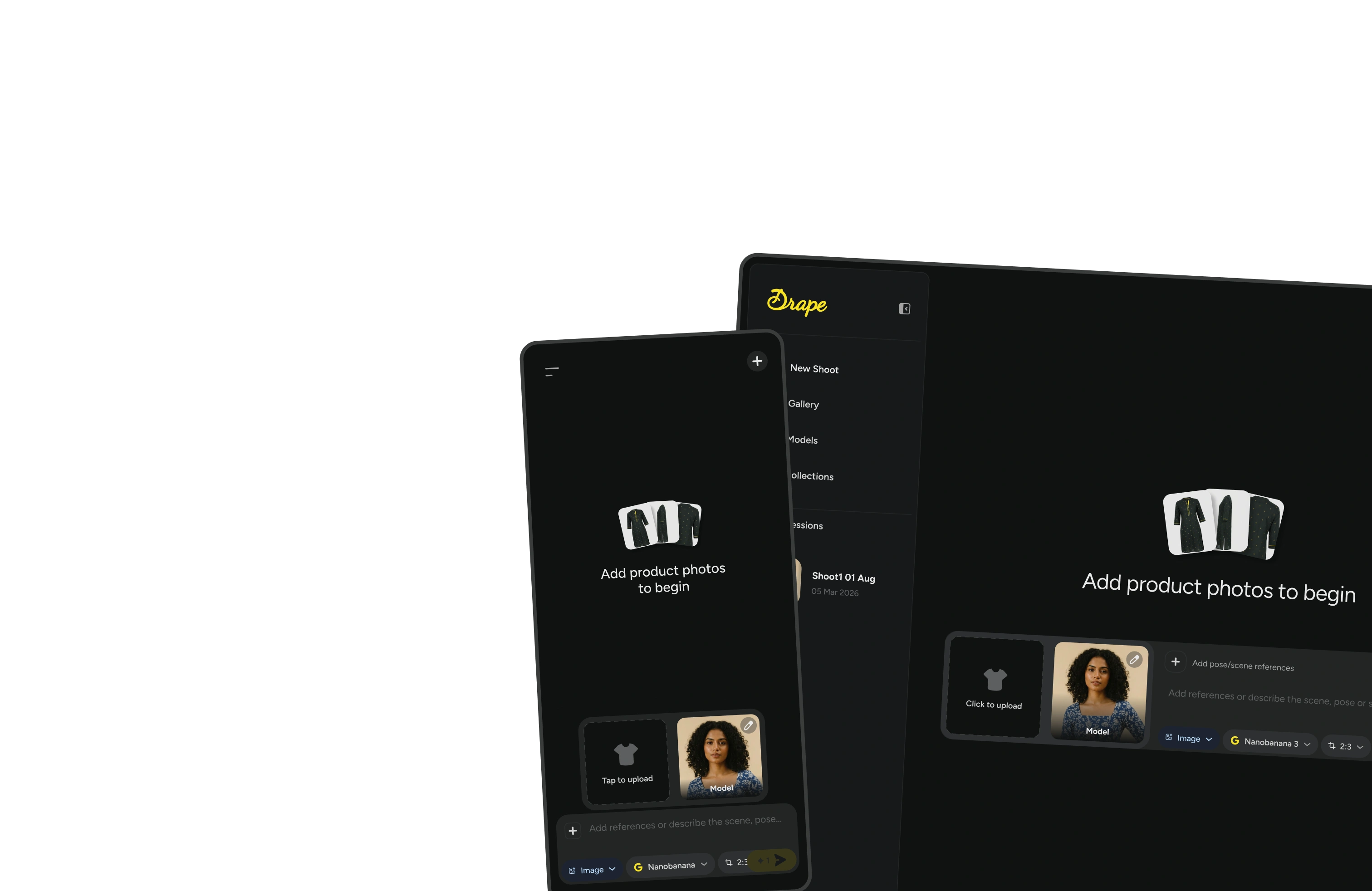
Drape
An AI product studio.
Product photos in, photoshoots out.





My role
3 months ago, I'd never built anything outside Figma.
01 / 03
Problem
A product shoot costs a small Indian seller ₹5,000–₹20,000.
Small sellers on Instagram, Meesho and Shopify need around fifty product photos per drop. Many are women-led boutiques. Most can't afford a photographer for each one.
Product
A seller uploads garment photos, casts a model, generates, refines and shares, all in a chat-style “shoot” session. The key differentiator: consistency the seller controls. Garments stay true across the whole shoot; pin a shot and its model and scene carry into the next pose, or recast with a new model any time.
Under it sits a full business: a gen-AI engine with multiple models to pick from, credit-based pricing with Razorpay payments, Hindi and English localisation, an admin dashboard that runs the business, and a mobile-first Next.js web app (PWA).
From shop photo to finished photoshoot
This is the real product, recorded as it runs in private alpha. A seller's suit photo goes in, a finished shoot comes out. Two recordings:
Upload the garment, pick a model, add a scene reference, tap Generate. Footage lightly sped up; the on-screen timer shows the true wait, about thirty seconds from tap to finished shot.
The second shot is where Drape earns it. Generative AI forgets everything between shots; the pin is the fix. Same model, same suit, same doorway, new pose. One tap, no re-explaining. A shoot stays a shoot.
02 / 03
Design
A design system run as a pipeline, enforced on every commit.
Colours, type and spacing are decided once, in Figma. One command rewrites the app's code to match. A gate on every commit blocks anything hand-typed, so the app can never drift from the design.
full palette change · under 15 minutes · by runbook
The system
The whole brand is three colours. A near-black and an off-white build the stage; a single high-energy yellow is the only voice on it.
In a product where the seller's photography must be the hero, the interface has one job: stay quiet until something matters.
Colour
67 colour tokens · resolved from these three
Typography
Figtree — sans and headings
64 · 48 · 40 · 32 · 24 · 20 — headings · lh 1.2
18 · 16 · 14 · 12 — body · lh 1.4 · footnote 10
Dancing Script, for brand moments
Radius
9 radii · 2 · 4 · 8 · 12 · 16 · 20 · 24 · 32 · full — at true size
Motion
--ease-drape · cubic-bezier(0, 0, 0.2, 1)
280ms · every UI state transition
106 tokens67 colour · 18 type · 9 radius · 5 stroke · 5 gap · 2 motion
every one checked on every commit ↑
03 / 03
I don't write code. I designed the system that produces it.
I read code and run commands; I don't write code. The product shipped because the collaboration itself is designed, with two users: me and the AI. Every feature starts as a written plan. Eight automatic checks run on everything the AI builds. The files that touch money stay locked unless the plan names them. And nothing ships before I read it; that review stop caught real bugs three times.
How a feature gets built.
Systems
Four production systems run Drape today. Each one exists because the product needed it, and each was designed before it was built.
Every photo passes through one doorway.
Under Drape's studio sits one engine, and every generation passes through its single doorway: the meter. It checks the seller's credits and only then calls the AI. Vendors plug in on the other side: Gemini powers it today, and GPT Image, Seedance, or any AI model would each be one new line of code.
 One doorwaymeter
Every credit is accounted for.
Credits are granted only by Razorpay's signed message, never by the browser claiming success. A repeat message is recognised and ignored. Each grant, spend, and refund lands as a row in an append-only ledger, and the balance is recomputed from the rows every time it's needed.
The control room
Drape's own dashboard, the tabs that run the business. A live activity tracker and Prompts, the workspace where prompt changes are drafted, A/B tested on the same seed, and published with a switch.
Decisions are logged constantly.
Every decision that changed a default is one dated line in a log, 487 entries so far, including the reversals. The system remembers why.